


Business vs Personal: Expense Examples
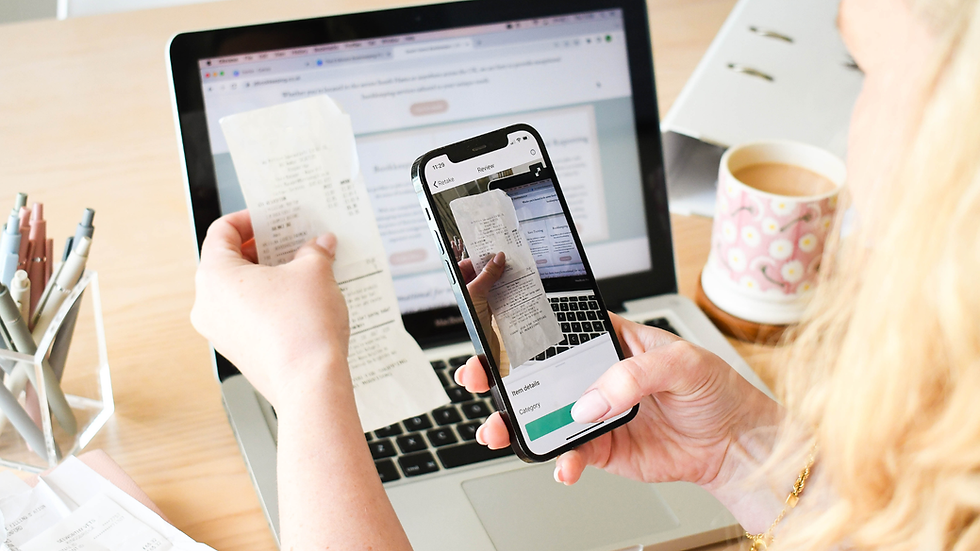
If you run your own business as a sole trader, there is a good chance that at some point you have stared at a receipt and thought: “Can I claim this?” You are not alone. It is one of the most common questions bookkeepers hear, and the answer is not always obvious.
The good news is that HMRC gives us a clear rule to work with. Once you understand it, the rest becomes a lot easier.
The Golden Rule: “Wholly and Exclusively”
HMRC allows sole traders to deduct expenses from their business income, but only those incurred “wholly and exclusively” for the purpose of the trade. That phrase is the test everything must pass.
It means the expense must have a clear, direct business purpose. If you bought it partly for personal reasons, or if a personal benefit crept in, the rules change (more on that shortly). If the expense is purely personal with no business case at all, it cannot be claimed.
Simple enough in theory. In practice, life as a sole trader means business and personal spending often blur together. Let us work through some real examples.
Clear Business Expenses You Can Claim
These are the expenses most sole traders are entitled to claim, and which pass the “wholly and exclusively” test without much debate.
Software subscriptions
If you pay for accounting software, project management tools, design platforms, or any other software used to run your business, that is a legitimate business expense. Think Xero, QuickBooks, Canva, Microsoft 365 used for work, all claimable.
Home office costs
Working from home? You can claim a proportion of your household costs, things like heating, electricity, and broadband, based on the amount of time and space used for business. HMRC also offers a simplified flat rate if you prefer to avoid the calculations.
Business mileage
If you use your own vehicle for business journeys (visiting clients, travelling to suppliers, attending networking events), you can claim the approved mileage rate. For the first 10,000 miles in a tax year, HMRC currently allows 55p per mile. Keep a mileage log, dates, destinations, and the purpose of each trip.
Professional development
Training courses, webinars, books, and qualifications that directly relate to your current trade can be claimed. A bookkeeper taking an updated AAT course, or a copywriter buying a course on SEO these are reasonable business expenses.
Networking events and business meals
Attendance fees for business networking events are generally claimable. Meals with clients follow slightly stricter rules (see the grey areas section below), but the cost of attending a structured business event usually qualifies.
Business phone calls
If you have a dedicated business phone, the full cost is claimable. If you use one phone for everything, the business proportion of your bill can be claimed.
Advertising and marketing
Website hosting, domain renewals, paid ads, social media management, and the costs of printing business cards or flyers all count as marketing expenses. If you spend money to promote your business, it is worth checking whether it qualifies.
Professional fees
Accountancy fees, bookkeeping fees, and the cost of professional memberships relevant to your trade are all claimable.
Personal Expenses You Cannot Claim
These are the expenses that do not pass the “wholly and exclusively” test and trying to claim them could cause problems with HMRC.
Personal clothing
You cannot claim for everyday clothes, even if you wear them to client meetings. The exception is specialist clothing required for the job; a uniform with a company logo, safety equipment, or protective gear. A smart suit bought for a client presentation does not qualify, because you could wear it outside of work too.
Family meals
A meal out with your partner or family is a personal expense, full stop. The business purpose must be the primary reason for the expense, not a social occasion that happened to include a brief work chat.
Personal phone calls
If your phone bill includes a mix of business and personal calls, only the business proportion is claimable. The personal element cannot be included.
The weekly shop
Even if you picked up coffee and biscuits for a client meeting during your regular supermarket run, you cannot claim the whole shop. You would need a separate, specific receipt for the business-related items.
Personal subscriptions
Netflix, Spotify, gym memberships, and similar personal subscriptions do not qualify, unless you can demonstrate a very specific, direct business use. That is a high bar to clear.
Grey Areas: Dual-Purpose Expenses
This is where it gets interesting. Many sole traders have expenses that serve both a business and a personal purpose. HMRC recognises this, and in some cases allows you to claim the business proportion.
Your mobile phone
If you use one phone for both personal and business use, you can calculate the percentage that is genuinely business-related and claim that portion. Keep records to support your calculation; call logs, for example, or a reasonable estimate based on your working patterns.
Your home broadband
Similarly, if your broadband serves both household and business use, an appropriate proportion can be claimed as a home office cost.
A car used for both business and personal travel
HMRC does not allow you to claim the full running costs of a car that is also used privately. Instead, use the approved mileage rate for your business journeys and keep a log. You cannot claim for the commute to a regular fixed place of work, but travelling to client sites, suppliers, or other business locations counts.
Lunch when working away
If you are travelling away from your usual place of work for business, a meal can be claimable as a subsistence expense. If you are simply eating lunch at your desk at home, it is not.
The key with dual-purpose expenses is to be honest about the split, keep clear records, and only claim what you can genuinely justify as a business cost.
A Note on Keeping Records
HMRC expects sole traders to keep clear records of their business income and expenses, typically for at least five years after the relevant tax return deadline. That means holding on to receipts, invoices, bank statements, and any supporting documents that back up your claims.
If you are ever asked to explain an expense, you want to be able to point to a clear paper trail. Good records protect you and make the whole process of filing your Self Assessment far less stressful.
If you are unsure whether an expense qualifies, the safest approach is always to ask your bookkeeper. It is a much better conversation to have before you claim something than after.
Not Sure Where Something Falls?
Getting the line between business and personal right matters, both for making the most of what you are entitled to claim and for staying on the right side of HMRC.
If you have a receipt on your desk and you are not sure which category it belongs in, Josie Dayment Bookkeeping is here to help. Getting in touch early means you can make informed decisions throughout the year, rather than scrambling at Self Assessment time.
Reach out today and let us make your expenses straightforward.


Comments